Most dinner cruises in Amsterdam sell you a seat. A private dinner cruise sells you the boat. That difference sounds small on a booking page and turns out to be the whole evening once you are on the water. Here is what actually changes, how dinner works on board and the questions worth asking before you book anything.
Key takeaways
- On a private dinner cruise in Amsterdam the boat is reserved for your group alone. No shared tables, no other bookings, no fixed departure you have to fit into.
- Because nothing is pre-packaged, the menu, the route, the timing and the pace are decided with you rather than handed to you.
- A covered saloon boat works all year. Sides and roof open in summer, closed and warm in winter.
- Private does not automatically mean expensive per person. With a full group the cost per head often lands close to a restaurant with a view.
- Private boats are booked as a whole, so the good evening slots in spring and summer go early. Ask about availability before you settle on a date.
What is a private dinner cruise in Amsterdam?
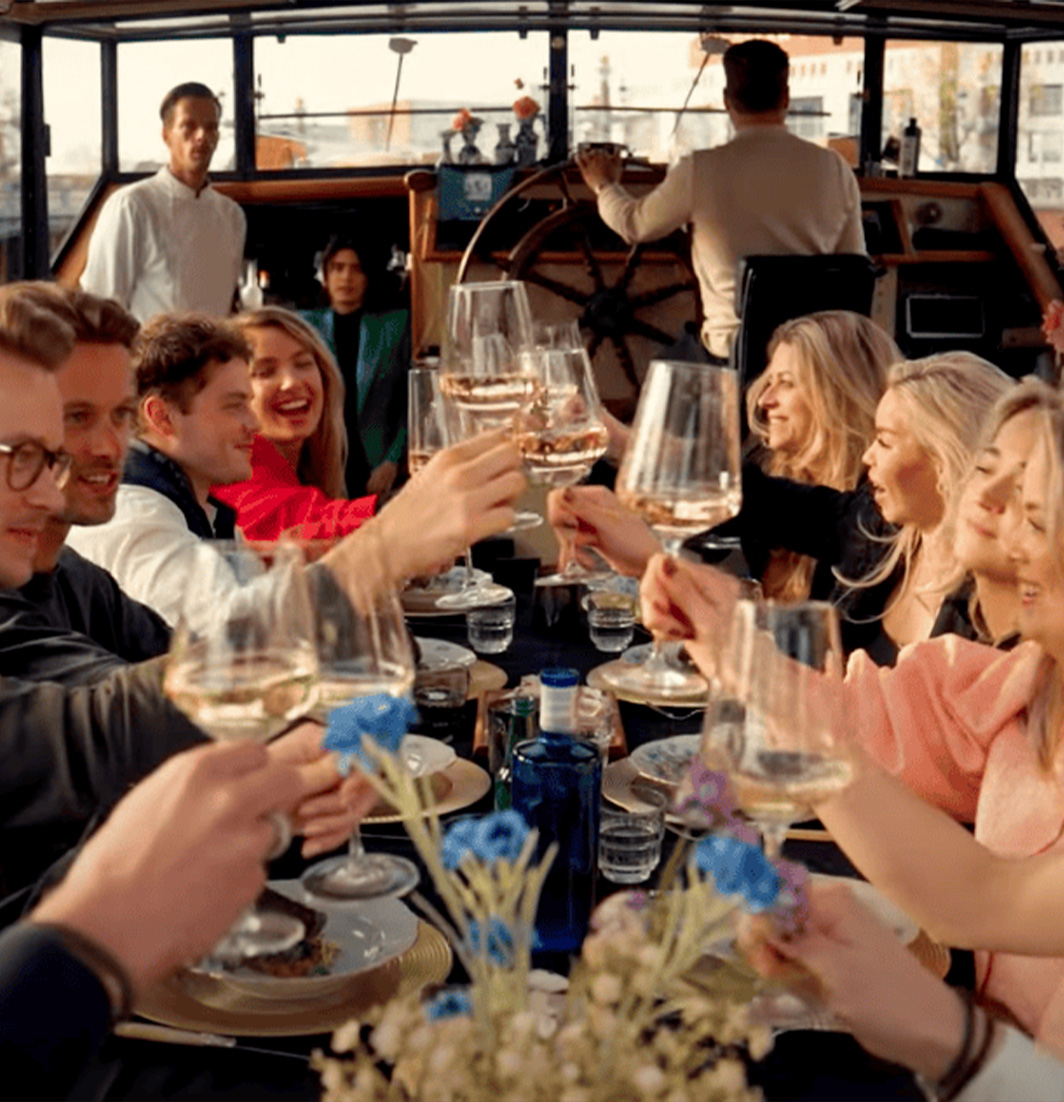
A private dinner cruise in Amsterdam is a canal cruise where you book the entire boat for your own group and dinner is served on board while you sail. Nobody else joins. That is the single difference that sets it apart from a regular dinner cruise, where you buy individual tickets and share the vessel, the schedule and usually the menu with other guests you have never met. On a private boat the group sets the tone: you decide who is there, what is served, how long you stay at the table and whether the evening is a quiet dinner or something louder.
In practice it also changes what the evening is for. Shared dinner cruises are built to work for everyone, which means they work moderately well for everyone. A private boat can be built around one occasion, whether that is a birthday, a client dinner, an anniversary or a family who happens to be in the same city for once. That is how our private dinner cruises are put together.
What you actually get that a ticketed cruise cannot give you
Your own group, and only your group. This is the obvious one, and it is still the reason most people end up looking for a private boat in the first place. Conversation works differently when the table next to you is also your table.
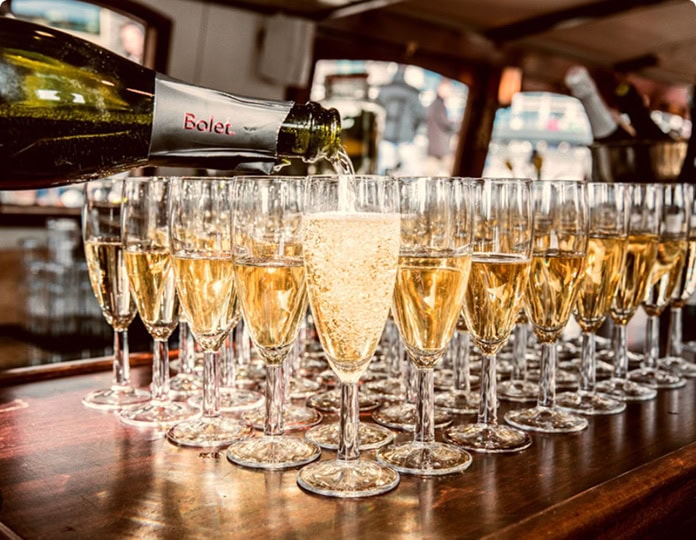
A menu that is yours. On a shared cruise the kitchen serves one menu to everyone on board. On a private boat the food is arranged for your group, in collaboration with caterers and chefs, which means dietary requirements are part of the plan instead of a problem to work around at the last minute. You can have a chef cook on board if you want the food to be the centre of the evening.
A pace you set. Scheduled cruises run to the clock because the boat has another departure after yours. A private booking does not, so a long dinner can stay long.
A boat with some character. We sail the Para Todos, an Amsterdam tugboat built in 1924 that was restored and fitted out as a saloon boat. It is worth saying plainly that this matters less than people expect when they are browsing and more than they expect once they are aboard. You can see the boat here.
How dinner works on board
There are three formats that work well on the water, and the right one depends less on taste than on what you want the evening to do.
A seated three-course dinner. Everyone at the table, courses served in sequence. This is the format for an occasion with a centre to it: a celebration, a client dinner, a toast somebody has to make. It is also the most comfortable option if your group includes people who would rather not stand for two hours.
Shared dining. Dishes in the middle, everyone reaching across. Less formal, more talking, and in our experience the easiest format for a group where not everyone knows each other yet.
A walking dinner. Small courses served while people move around the boat. This is the one to pick when mingling matters more than sitting, which is usually the case for company events and larger celebrations. It also fits more people on board than a seated dinner does, because you are not committing the floor space to a table.
If you are weighing these up, the dinner options and the food and drinks page go into more detail on what each one involves.
What to sort out before you book
A few things decide more about the evening than the menu does, and they are easier to settle early.
The season. A covered saloon boat is not a summer product. In warm weather the sides, back and roof open up and you are essentially dining outside. In winter it closes and stays warm, and the canals in December with the lights on the water are arguably the better version. What you do want to know in advance is which configuration you are getting, because an open boat in October is a different evening than a closed one.
The group size, honestly counted. Private boats are booked whole, so the cost works out per boat rather than per person. A group that fills the boat pays a sensible amount per head. A group of six paying for a boat that holds considerably more will notice. Neither is wrong, but it is worth knowing which situation you are in before you compare prices with a restaurant.
Timing against the date. Spring and summer evenings are the first slots to go, and so is the run-up to the holidays. If the date is fixed, ask about availability first and build the rest of the evening around the answer.
Planning an evening on the water
The useful first message is short: the date, roughly how many people, and what the evening is for. That is enough to say whether it is possible and which dinner format fits. The menu, the drinks and the route are easier to decide once those three things are settled, and they are the enjoyable part anyway.
Request a private dinner cruise or get in touch if you would rather talk it through first.
Frequently asked questions
How many people can join a private dinner cruise in Amsterdam?
That depends on the boat and on the dinner format. A seated dinner needs room for a table, so it takes fewer guests than a walking dinner on the same boat. Because a private cruise is booked as a whole boat rather than per ticket, it is worth giving your group size in your first message so you get an answer that applies to your situation rather than a general range.
Can you do a private dinner cruise in winter?
Yes. A covered saloon boat closes up in cold or wet weather and stays warm inside, so the season is not a limitation. Many people find winter the better time for it, because the city looks different from the water in the dark and the canals are quieter than in July.
Can we choose our own menu?
Yes. This is one of the main differences from a ticketed dinner cruise, where everyone on board eats the same fixed menu. On a private boat the food is arranged for your group together with caterers and chefs, so you can match it to the occasion and deal with dietary requirements as part of the planning rather than as an exception.
How long does a private dinner cruise last?
Long enough for dinner to be dinner rather than a service window, which is one of the practical advantages of booking the whole boat instead of a seat on a scheduled departure. The exact duration is agreed when you book and depends on the format you choose, since a three-course seated dinner and a walking dinner do not run to the same rhythm.
Is a private dinner cruise worth it compared to a restaurant?
It depends on what you want from the evening. A restaurant with a canal view gives you one view for the whole dinner. A boat gives you the city moving past the table, and the group has the space to itself, which is hard to arrange in a restaurant without booking a private room. For an occasion that needs to feel like something, the boat tends to win. For a straightforward dinner with no reason behind it, a restaurant is simpler.